

You can have a normal weight on the scale and still carry the kind of fat that quietly pushes your blood sugar in the wrong direction. That fat sits around your waist, and doctors pay close attention to it. If you have ever wondered why belly fat raises your diabetes risk, you are asking the right question.
In this guide, you will learn what belly fat actually does inside your body, how it links to type 1 and type 2 diabetes, and what you can do about it starting this week.
Why Belly Fat Raises Your Diabetes Risk: The Short Answer
Belly fat raises diabetes risk because deep abdominal (visceral) fat releases fatty acids and inflammatory chemicals that make your cells resist insulin. When cells ignore insulin, sugar stays in your blood, and over time the pancreas can no longer keep up.
That is the whole story in two sentences. The rest of this article explains each piece in plain language.
Not All Fat Is the Same: Visceral vs. Subcutaneous
Fat under your skin (subcutaneous fat) is the soft layer you can pinch. Visceral fat is different. It sits deep inside your abdomen, wrapped around organs like the liver, pancreas, and intestines.
Visceral fat is metabolically active. It behaves almost like an organ that sends out signals. Those signals include inflammatory proteins and free fatty acids that travel straight to the liver through a nearby blood vessel. Researchers at the Harvard T.H. Chan School of Public Health have long highlighted that waist size and abdominal fat predict diabetes risk better than body weight alone.
The Relationship Between Fat and Diabetes
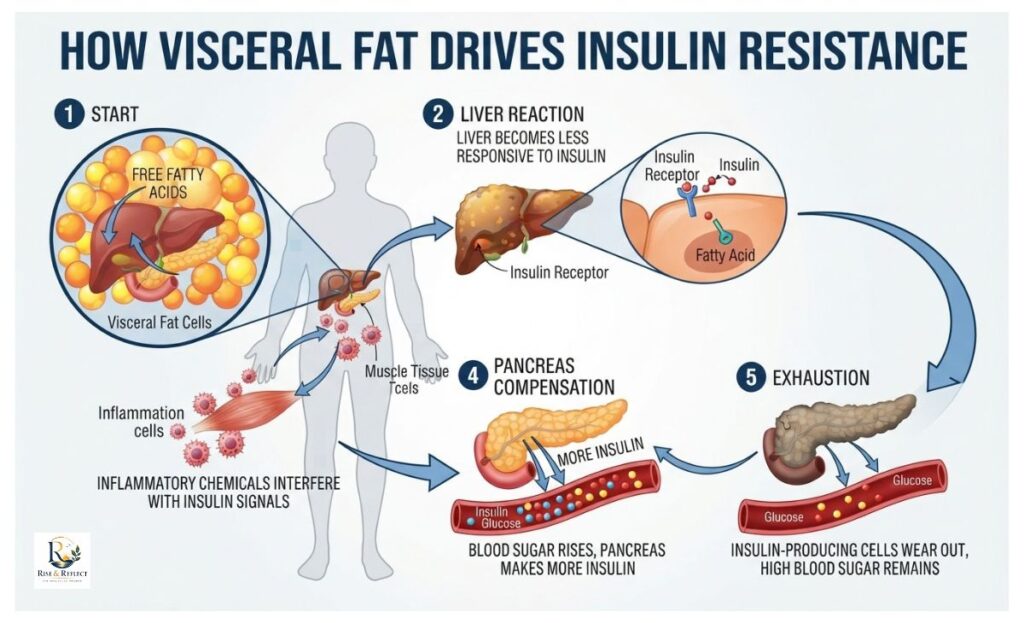
The relationship between fat and diabetes is not about how much you weigh. It is about where the fat is stored and what it does.
How Visceral Fat Drives Insulin Resistance
Here is the chain of events:
- Visceral fat cells release free fatty acids into the liver.
- The liver stores some of that fat and becomes less responsive to insulin.
- Inflammatory chemicals from fat tissue interfere with insulin signals in muscle and liver cells.
- Blood sugar rises, so the pancreas makes more insulin to compensate.
- Eventually, the insulin-producing cells wear out, and blood sugar stays high.
This is the core reason belly fat raises your diabetes risk more than fat on the hips or thighs.
Relationship Between Obesity and Type 2 Diabetes
The relationship between obesity and type 2 diabetes is one of the strongest in medicine. The Centers for Disease Control and Prevention (CDC) lists excess weight as a leading risk factor for type 2 diabetes, along with age, family history, and inactivity.
Does obesity cause diabetes type 2? Obesity does not cause it on its own, but it is a major driver. Many people with obesity never develop diabetes, and some people at a healthy weight do. Genetics, sleep, stress, and diet all play a part. Still, central obesity (fat concentrated at the waist) makes insulin resistance far more likely.
Diabetic Belly Fat Type 2: What Is Going On?
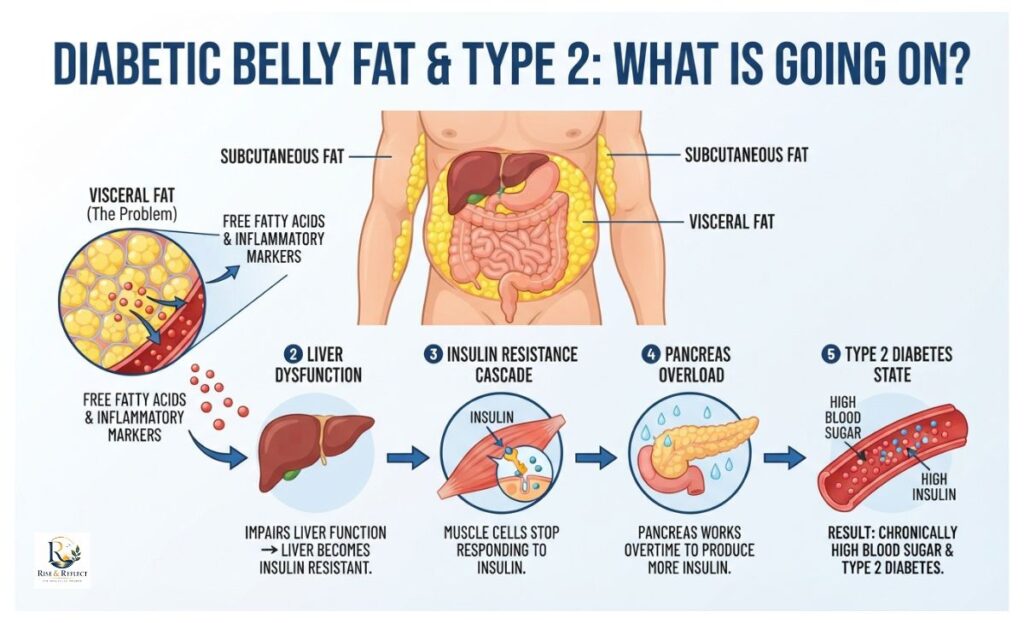
People with type 2 diabetes often notice weight gathering around the middle even when they eat modestly. High insulin levels encourage the body to store fat, especially in the abdomen. That extra fat then worsens insulin resistance. It becomes a cycle, which is why diabetic belly fat in type 2 can feel so stubborn.
Does Obesity Cause Diabetes Type 1?
No. Obesity does not cause type 1 diabetes. Type 1 is an autoimmune condition in which the immune system attacks the insulin-producing cells in the pancreas. Lifestyle choices do not trigger it.
Diabetic Belly Fat Type 1: Why It Still Happens
Even though weight does not cause type 1, some people with it do gain belly fat. Reasons include:
- Insulin therapy can promote fat storage if doses are not matched to food intake.
- Treating frequent low blood sugar with extra snacks adds calories.
- Modern lifestyles mean many people with type 1 also develop insulin resistance, sometimes called “double diabetes.”
So the logic of why belly fat raises your diabetes risk applies mainly to type 2, but belly fat can still make type 1 harder to manage by raising insulin needs.
Why Belly Fat Raises Your Diabetes Risk: Know Your Numbers
Waist measurement is a simple screening tool. Use a tape measure at the level of your belly button after breathing out normally.
| Group | Lower Risk Waist | Higher Risk Waist |
| Men | Under 94 cm (37 in) | Over 102 cm (40 in) |
| Women | Under 80 cm (31.5 in) | Over 88 cm (35 in) |
| South Asian adults* | Under 90 cm (men) / 80 cm (women) | Above these values |
*South Asian populations tend to develop diabetes at lower body weights, so lower cut-offs are often used.
A waist above the higher-risk number does not mean you have diabetes. It means a blood sugar test is a smart idea.
How to Get Rid of Insulin Resistance Belly Fat
There is no magic trick, but there is a proven approach. Studies such as the Diabetes Prevention Program, supported by the U.S. National Institutes of Health, found that losing about 5 to 7 percent of body weight and walking regularly cut the risk of developing type 2 diabetes by more than half in high-risk adults.
Here is what works:
- Move daily. Aim for 150 minutes of brisk walking per week. Add two strength sessions, because muscle uses blood sugar efficiently.
- Cut sugary drinks. Sodas, packaged juices, and sweet tea spike insulin fast.
- Build meals around fiber and protein. Lentils, vegetables, eggs, fish, and yogurt keep blood sugar steadier.
- Sleep 7 to 8 hours. Poor sleep raises cortisol, which encourages belly fat.
- Manage stress. Chronic stress hormones push fat toward the abdomen.
- Don’t rely on crunches. You cannot spot-reduce belly fat. Whole-body habits shrink it.
If you take diabetes medication, talk to your doctor before changing your diet or exercise routine so doses can be adjusted safely.
Common Warning Signs to Watch For
Insulin resistance often has no symptoms for years. If your waist is above the risk range and you notice fatigue, constant thirst, or darkened skin on the neck or armpits (acanthosis nigricans), ask for an HbA1c or fasting glucose test.
Frequently Asked Questions
What is the fastest way to reverse diabetes?
There is no instant cure, but type 2 diabetes can go into remission with significant weight loss, a balanced diet, and regular activity, ideally under medical supervision. Early action gives the best chance.
What are 10 warning signs of diabetes?
Frequent urination, excessive thirst, constant hunger, unexplained weight loss, fatigue, blurred vision, slow-healing sores, frequent infections, tingling in hands or feet, and dark skin patches. See a doctor if you notice several.
How to destroy belly fat naturally?
Combine daily walking, strength training, enough sleep, and a diet rich in whole foods with fewer refined carbs and sugary drinks. Consistency beats extreme dieting.
What are the 5 superfoods to burn belly fat?
No food burns fat by itself, but these help: lentils and beans, leafy greens, oats, berries, and nuts like almonds. Their fiber and protein keep you full and blood sugar steady.
What are the worst foods for belly fat?
Sugary drinks, white bread and pastries, deep-fried snacks, processed meats, and sweets. These raise insulin quickly and are easy to overeat.
Final Thoughts: Why Belly Fat Raises Your Diabetes Risk
Now you know why belly fat raises your diabetes risk: deep abdominal fat sends signals that blunt insulin, strains the pancreas, and sets the stage for type 2 diabetes. The encouraging part is that even modest weight loss around the waist makes a measurable difference.
Your next step: grab a tape measure tonight, record your waist size, and book a simple blood sugar test with your doctor. Then pick one habit from this article, such as a 30-minute daily walk, and start tomorrow.
This article is for general education and is not a substitute for professional medical advice.
References
- Harvard T.H. Chan School of Public Health, Obesity Prevention Source: “Diabetes” and abdominal fat resources.
- Centers for Disease Control and Prevention (CDC): “Diabetes and Obesity” / Diabetes Prevention Program overview.