

Everyone wants to talk about what to eat when they’re trying to drop weight protein grams, calorie apps, whether almond butter counts as “clean.” Fair enough. But there’s a quieter piece of the puzzle that doesn’t get nearly as much attention: when you eat. If you’ve ever finished a late dinner and thought, “this probably isn’t helping,” you were onto something.
This guide walks through the best time to eat for weight loss based on actual research (not Instagram wisdom), unpacks the 3-3-3 rule everyone keeps mentioning, takes an honest look at whether you can really lose 5kg in a week, and answers whether 10kg in two months is even doable. No miracle promises just a framework you can actually use starting tomorrow.
Why Meal Timing Actually Matters
Your body handles food differently at 8 a.m. than it does at 11 p.m., and that’s not a wellness-blog talking point — it comes down to your circadian rhythm, the internal clock that runs your hormones, digestion, and metabolism on a roughly 24-hour cycle. During the day, your body is generally better at processing glucose and burning through what you eat. Once night hits, it shifts gears toward rest and repair, and it just doesn’t handle food as efficiently.
So when researchers ask what the best time to eat for weight loss is, the answer keeps landing in the same place: earlier. Front-load your calories instead of saving the big meal for 9 p.m. There’s a well-known 2013 study out of Spain that followed 420 overweight women through a 20-week weight-loss program. The women who ate lunch (the main meal, in this case, since it’s Spain) before 3 p.m. lost noticeably more weight than the ones who ate after 3 p.m. and this wasn’t because the early eaters exercised more or ate fewer calories. Those factors were basically identical between groups. Timing was the difference.
More recent work published in Cell Metabolism points the same direction. Researchers found that eating on a later schedule left people hungrier over a full 24 hours, slowed how fast they burned calories, and pushed their fat tissue to store more energy than when the same food was eaten earlier in the day.
What Is the 3-3-3 Rule for Weight Loss?
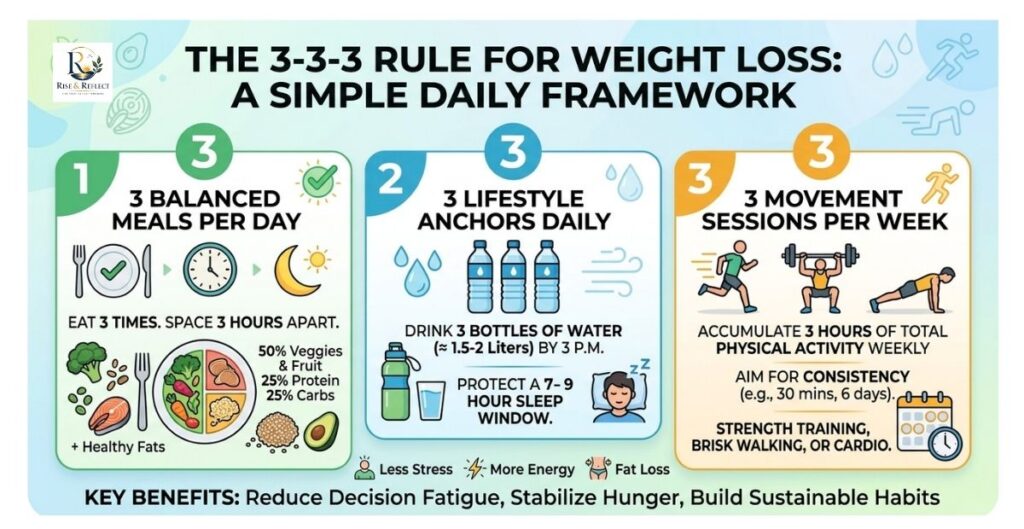
This one’s everywhere right now, so let’s clear it up: what is the 3-3-3 rule for weight loss? There are a few versions floating around online, but the one most nutrition coaches actually recommend boils down to three habits:
- Three balanced meals a day, spaced about 3–4 hours apart, so your blood sugar doesn’t crash and send you raiding the pantry.
- A 3-hour buffer before bed with no food, giving your digestive system a chance to settle before you sleep.
- Three liters of water daily, since a lot of “hunger” is really just mild dehydration in disguise.
What makes the 3-3-3 rule appealing is that it isn’t really a diet it’s a rhythm. Nobody’s asking you to weigh your rice. You’re just building habits around structure, hydration, and a cutoff time, which happens to line up with what the research says is the best meal timing for fat loss anyway.
What’s the Best Meal Timing for Fat Loss?
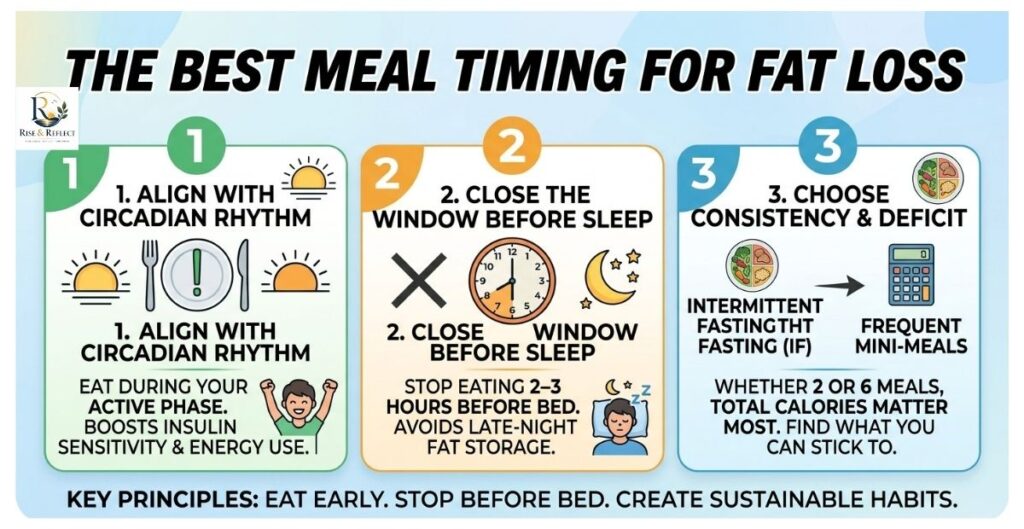
If there’s one takeaway here, it’s this: consistency beats perfection, every time. Still, a few specific habits show up again and again in the research.
Eat breakfast within an hour or two of waking up
This helps set your hunger hormones ghrelin and leptin for the rest of the day, and it lowers your odds of hitting an energy slump that sends you snacking by 11 a.m.
Make lunch your biggest meal, not dinner
Insulin sensitivity tends to be higher earlier in the day, so your body simply processes a bigger meal better at lunchtime than it does at 8 p.m.
Wrap up dinner by 7 or 8 p.m.
Eating late — especially past 9 p.m. keeps showing up in studies linked to weight gain and worse metabolic markers. One large study following over 100,000 adults found people who ate their last meal after 9 p.m. had a meaningfully higher risk of cardiovascular problems.
Stick to an 8–10 hour eating window
Time-restricted eating, essentially just squeezing your meals into a shorter daily window, has been shown in research out of Northwestern Medicine to work about as well as calorie counting for weight management and for a lot of people, it’s just easier to stick with.
Put it all together and that’s basically the best time to eat for weight loss: front-loaded, reasonably structured, and finished well before you’re winding down for bed.
Sample Daily Eating Schedule
| Meal | Best Time | Why It Works |
| Breakfast | 7:00–8:30 a.m. | Kickstarts metabolism, stabilizes blood sugar |
| Lunch (largest meal) | 12:00–2:00 p.m. | Peak insulin sensitivity, better calorie processing |
| Snack | 3:30–4:30 p.m. | Prevents evening overeating |
| Dinner | 6:30–7:30 p.m. | Allows digestion before sleep, supports fat metabolism |
| Water intake | Spread through the day | Cuts down on false hunger cues |
How to Lose 5kg in 7 Days: A Realistic Meal Plan
People search for “how to lose 5kg in 7 days meal plan” constantly, so let’s be straight about it: dropping 5kg of actual fat in seven days isn’t realistic, and it’s not really safe either. A sustainable pace is closer to 0.5–1kg a week. What you can see on the scale in a week through less bloating, lower water retention, and a real calorie deficit — is a genuinely noticeable drop. Here’s a plan that leans on everything above:
- Breakfast (7–8 a.m.): Eggs or Greek yogurt with berries — keeps you full and heads off mid-morning cravings.
- Lunch (12–1 p.m.): Lean protein (chicken, fish, tofu, lentils) with vegetables and a modest amount of carbs.
- Snack (around 4 p.m.): A handful of nuts or a piece of fruit.
- Dinner (6:30–7 p.m.): Something light, protein and vegetables mostly, easy on the refined carbs.
- Movement: 30–45 minutes of walking or light cardio daily, plus cutting back on sodium and processed food to bring down water retention.
Cut the liquid calories, ease up on salt, eat whole foods, and stop eating three hours before bed. That combination not a crash diet is what actually shows results in a week.
Can I Lose 10kg in 2 Months?
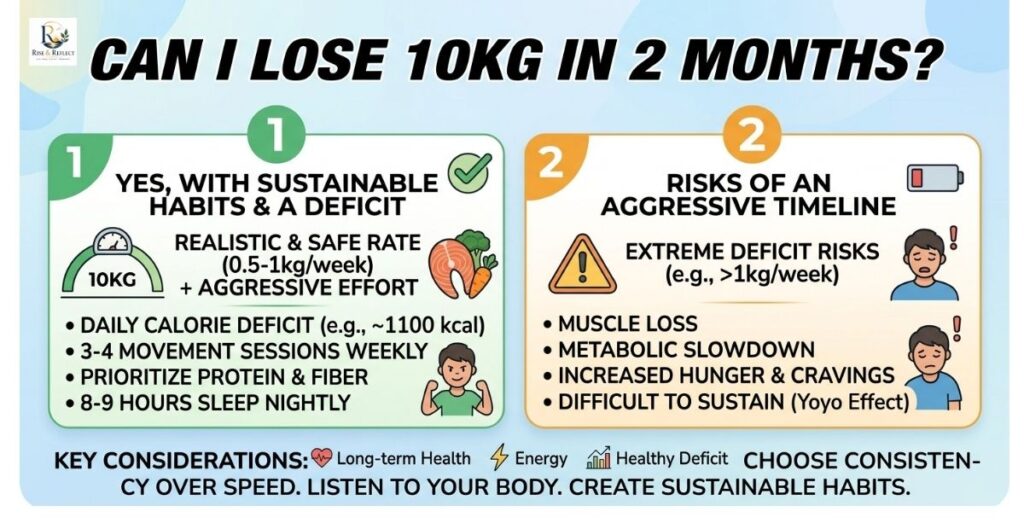
For a lot of people, yes, this is doable and reasonably healthy it just depends where you’re starting from. Ten kilos over eight weeks works out to about 1.25kg a week, which is on the higher end of what’s usually considered safe, particularly if you’re starting from a higher body weight. To get there, you generally need:
- A steady daily calorie deficit, not starvation-level restriction
- Regular strength and cardio training, so you’re losing fat and not muscle
- The meal-timing habits above: earlier calories, an earlier dinner, a defined eating window
- Actual sleep, since poor sleep messes with hunger hormones and undoes a lot of the work
If you’ve got a fair amount of weight to lose, this pace is realistic. If you’re already close to your goal, aim lower and check in with a doctor or dietitian before pushing an aggressive timeline.
Mistakes That Quietly Undo Good Meal Timing
- Skipping breakfast, then overeating at 9 p.m. to make up for it
- Making dinner your biggest meal instead of lunch
- Mistaking thirst for hunger and snacking unnecessarily
- Going 5–6+ hours without eating, which almost always backfires at the next meal
- Sleeping poorly and wondering why hunger feels out of control
Frequently Asked Questions
What is the laziest way to burn fat? Walk more (aim for 8,000–10,000 steps a day), drink enough water, and eat most of your protein earlier in the day. None of that requires a gym membership or willpower of steel — it’s the lowest-effort path that actually works.
Can I eat rice and still lose weight? Yes. Rice isn’t the enemy portion size and what you pair it with matter far more. Have it earlier in the day with protein and vegetables and it fits into a weight-loss plan just fine.
What foods should I avoid when losing weight? Sugary drinks, deep-fried food, white bread and pastries, and heavily processed snacks are the usual culprits. They’re calorie-dense, low on nutrients, and tend to spike your blood sugar, which makes you hungrier later.
Is rice empty calories? Not really. Rice, especially brown or whole-grain, carries carbohydrates, some fiber, and micronutrients it’s nothing like a can of soda. Portion control matters more than cutting it out entirely.
What are five foods I should eat to lose weight? Eggs, leafy greens, lean protein like chicken or fish, Greek yogurt, and legumes such as lentils or chickpeas. All filling, all nutrient-dense, all easy to build a calorie deficit around.
Make Meal Timing Work for You
If you’ve been Googling around for the best time to eat for weight loss, here’s the truth: it’s not about flipping your entire life upside down overnight. It really comes down to shifting more of your calories earlier in the day, giving your body a genuine break before bed, and showing up consistently instead of obsessing over doing it perfectly.
That’s honestly the whole secret behind the best time to eat for weight loss — no fancy tricks, no starvation windows, just smarter timing. Pair that with real, whole foods, a bit of daily movement, and actually decent sleep, and your body has pretty much everything it needs to drop weight in a way that sticks around.
So if you’re still wondering what the best time to eat for weight loss actually looks like in practice, start tomorrow: eat breakfast within an hour of waking up, make lunch your biggest meal of the day, and try to have dinner wrapped up by 7:30 p.m.
Nail down the best time to eat for weight loss and stop chasing extreme diets — small, boring, repeatable habits are what actually work in the long run.