
Having a baby is one of those experiences that changes everything, including your body and honestly, the physical side of it can catch you off guard. After delivery, a lot of mothers notice extra weight sitting around the belly, hips, and thighs, and it’s natural to start wondering when you can exercise again, what you should actually be eating, and how long it’ll take before you feel like yourself.
Here’s the reassuring part: getting back to a healthy weight after a normal vaginal delivery doesn’t require a strict diet or brutal workouts. What it actually takes is time enough for your body to recover paired with changes you can realistically stick with.
If you’re trying to figure out how to start weight loss after normal delivery, this guide covers when to begin, what to eat, which exercises make sense, and how to handle the postpartum weight concerns that come up for almost everyone.
One thing worth saying upfront: no two recoveries look the same. Your health, how your delivery went, whether you’re breastfeeding, how much sleep you’re getting all of it shapes your timeline.
1. When Should You Start Weight Loss After Normal Delivery?
This is probably the question new mothers ask most.
After a healthy vaginal delivery, gentle movement short walks, basically can often start within a few days if your body feels up to it. But there’s a real difference between moving gently and actually starting a weight-loss plan or a demanding workout routine.
The American College of Obstetricians and Gynecologists notes that women who had healthy pregnancies and vaginal deliveries can typically ease back into exercise once they feel ready, though anyone who had complications should get individual guidance from their provider rather than following a general timeline.
The First Six Weeks
Recovery should be the only real priority here. That means:
- Resting whenever you can grab it
- Eating meals that actually nourish you
- Drinking water consistently
- Taking short walks if and when you feel ready
- Sticking to whatever recovery instructions your provider gave you
Don’t push for fast weight loss during this window. Your body just went through pregnancy and childbirth it needs the runway.
After Your Six-Week Checkup
Once you’ve had that checkup, many women can start building up their activity level, depending on how recovery is going. If you feel well and your provider gives the okay, a more structured routine becomes reasonable just start light and build from there.
Worth repeating: six weeks isn’t a hard deadline for everyone. If you dealt with significant tearing, pelvic floor issues, heavy bleeding, or anything else complicated, you may need more time, and that’s completely normal.
2. How to Start Weight Loss After Normal Delivery With Healthy Eating
Food is honestly one of the most practical levers you have here.
You don’t need to starve yourself, skip meals, or cut carbs entirely. What actually helps is balanced meals enough protein, fiber, energy, and the vitamins and minerals your body’s using to repair itself.
Lean into protein. It’s doing a lot of the heavy lifting when it comes to tissue repair and keeping your muscle intact. Eggs, chicken, fish, beans, lentils, plain yogurt, chickpeas, nuts any of these work. Eggs on whole-wheat toast for breakfast, or lentils with vegetables at lunch, are easy starting points.
Don’t skip fruits and vegetables. They bring fiber, water, and a wide range of vitamins and minerals to the table. Add vegetables into your main meals where you can, and reach for whole fruit — apples, oranges, guava, berries instead of processed snacks.
Think in terms of balance, not restriction:
| Food Group | Examples | Why It Matters |
| Protein | Eggs, chicken, lentils, fish | Repairs tissue, maintains muscle |
| Vegetables | Spinach, carrots, cucumber, broccoli | Fiber, vitamins, minerals |
| Whole grains | Oats, whole-wheat roti, brown rice | Sustained energy and fiber |
| Healthy fats | Nuts, seeds, olive oil | Essential fats, steady energy |
| Fruits | Apples, oranges, guava, berries | Fiber, vitamins, minerals |
Adjust portions based on your appetite, activity, whether you’re breastfeeding, and what your provider recommends.
Skip the extreme dieting. Crash diets and severe calorie cuts just make it harder to get what your body needs while it’s healing. If you’re breastfeeding, your calorie needs actually go up the CDC puts the extra need at roughly 330 to 400 calories a day for well-nourished breastfeeding mothers, though this varies person to person.
3. Best Exercises for Weight Loss After Normal Delivery
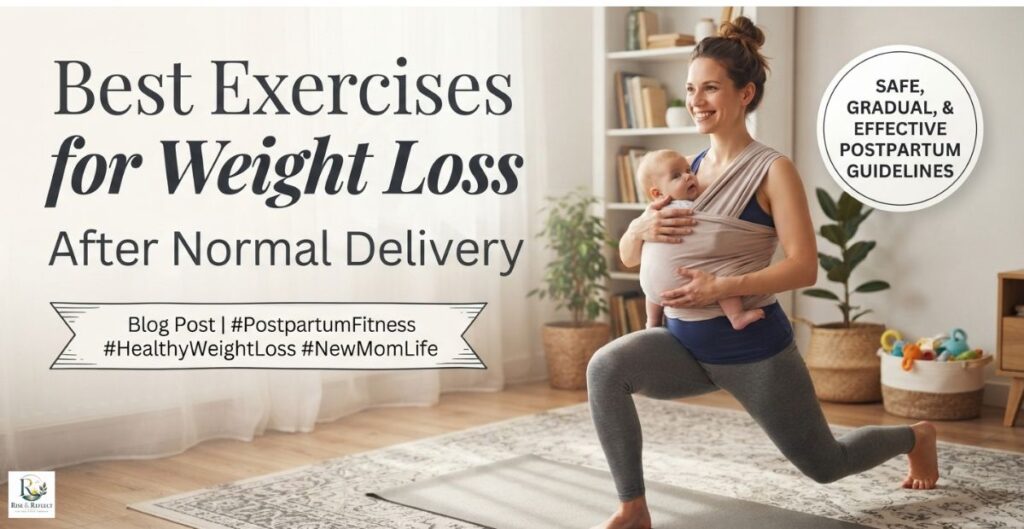
Exercise helps with more than the scale it supports physical recovery and can genuinely lift your mood during a period that’s often exhausting.
If exercise is part of your plan for how to start weight loss after normal delivery, start gentle. Don’t jump into anything demanding.
Walking comes first. A comfortable five- to ten-minute walk is a totally reasonable starting point. Build from there as your energy allows walk around the house first, extend the distance once you’re feeling stronger, and break it into a few shorter walks throughout the day if one longer stretch feels like too much. Stop and call your provider if you notice real pain, dizziness, or increased bleeding.
Gentle postpartum-specific movements are worth adding once you’ve got medical clearance things like pelvic floor exercises (Kegels), breathing work, light mobility movements, and gradual stretching. If you notice pelvic heaviness, leaking, abdominal doming, or pain during any of this, check in with a healthcare provider or pelvic health physiotherapist before pushing further.
Build up gradually. The CDC’s general target for healthy postpartum women is around 150 minutes of moderate aerobic activity a week but that’s not something you need to hit right out of the gate. Consistency matters far more than intensity here.
4. Why Is Your Belly Still Big After Delivery?
A lot of women expect a flat stomach shortly after birth. In reality, your uterus, abdominal muscles, skin, and other tissue all need real time to recover and a belly that’s still noticeable three months out doesn’t mean you’re doing anything wrong.
A few things could be going on:
- Your uterus is still shrinking this process takes weeks, not days
- Some pregnancy weight is simply still there
- Diastasis recti a separation of the abdominal muscles that happens during pregnancy and can leave a bulging look
- Skin that stretched during pregnancy can take a while to adjust, and sometimes doesn’t fully bounce back
- Bloating or constipation, which can make your stomach look and feel fuller than it is
If you’re dealing with a persistent bulge, pain, or a visible gap in your abdominal muscles, ask your provider whether an assessment or pelvic health physiotherapy makes sense. And skip the instinct to do endless sit-ups the right exercises depend entirely on what’s actually going on with your recovery.
5. How to Start Weight Loss After Normal Delivery While Breastfeeding
Breastfeeding increases your energy needhttps://www.cdc.gov/breastfeeding-special-circumstances/hcp/diet-micronutrients/maternal-diet.htmls, and for some mothers, it does help with weight loss. But it’s genuinely inconsistent some women lose weight steadily, others hold steady or even gain for a while, and neither outcome means you’re doing something wrong.
Eat enough to actually support breastfeeding. Oatmeal with milk and fruit, eggs on toast, yogurt with nuts, lentils with roti and vegetables, or chicken and rice regular, nourishing meals matter more than any specific food. Drink water often, especially around feeding times.
Steer clear of rapid weight loss. Skip restrictive diets and weight-loss products unless a professional has actually cleared them for you. Your needs depend on milk production, activity level, body size, and overall health there’s no one-size answer. If you’re worried about your supply, your baby’s growth, or your own changing weight, talk to your provider or a dietitian.
6. Common Postpartum Weight-Loss Mistakes to Avoid
Moving too fast tends to backfire. Some of the most common traps:
- Comparing yourself to other mothers. Every pregnancy and recovery is different, and social media rarely shows the full picture.
- Skipping meals. Regular, balanced eating actually supports your recovery it doesn’t work against it.
- Jumping into intense workouts too soon. Build up gradually and follow your provider’s guidance.
- Expecting a flat stomach within weeks. Abdominal recovery often takes months, and some changes may simply be permanent.
- Relying on slimming teas or weight-loss supplements. These carry real risks and often aren’t safe during breastfeeding.
- Ignoring sleep and stress. Newborn life disrupts both lean on family or friends for support where you can.
- Treating the scale as the only marker of progress. Strength, energy, stamina, and comfort all count too.
7. How Long Does It Take to Lose Weight After Normal Delivery?
There’s no single timeline that fits everyone.
Some weight comes off right at delivery and in the days after, as excess fluid leaves your system. The rest tends to come off more slowly, over the following months. MedlinePlus notes that many women lose about half their pregnancy weight by six weeks postpartum, with the remainder coming off gradually and frames six to twelve months as a general goal for returning to pre-pregnancy weight, not a strict deadline.
If you’re wondering how to start weight loss after normal delivery and how fast to expect results, gradual progress is almost always the more appropriate and honestly more sustainable — path than anything rapid.
What shapes your timeline:
- How much weight you gained during pregnancy
- Your pre-pregnancy weight and general health
- Whether you’re breastfeeding
- Your activity level and eating habits
- Sleep, stress, and hormonal shifts
- Any medical conditions or delivery complications
If anything feels off unexpected weight changes, unusual weakness, anything concerning bring it up with your provider.
A Simple Postpartum Routine to Get Started
Here’s a loose example for a mother who’s cleared to move and has no medical restrictions. Adjust it however fits your life.
Morning: Balanced breakfast, water, and a short walk if you’re feeling up to it.
Afternoon: A nourishing lunch with protein, vegetables, and some carbs. Rest when you can.
Evening: Another short walk, or gentle postpartum movements your provider has approved.
Throughout the day: Eat when you’re hungry, stay hydrated, and focus on recovery rather than chasing a calorie burn.
This isn’t a schedule you need to follow rigidly your baby’s feeding pattern and your own recovery should really be setting the pace.
Final Thoughts
Figuring out how to start weight loss after normal delivery really comes down to one thing: building habits you can actually sustain while giving your body the time it needs to heal. There’s no trick to it just consistency.
If you’re serious about how to start weight loss after normal delivery the right way, begin with good food, comfortable movement, enough water, and rest wherever you can grab it. Build activity gradually, and steer clear of crash diets or expectations that don’t match how bodies really heal.
This is your journey, on your own timeline. Learning how to start weight loss after normal delivery isn’t a race, and it’s not something that needs to be rushed or measured against anyone else’s progress.
Ready to start? The truth about how to start weight loss after normal delivery is that it begins small pick one thing today. A short walk, a balanced meal, or asking someone for an hour of rest is enough to begin with.
Once you understand how to start weight loss after normal delivery in a way that fits your own body and schedule, small, steady steps add up faster than most people expect.
Frequently Asked Questions
How much weight loss after delivery in kg?
Many women lose around 4–6 kg during childbirth and the days right after, though this varies quite a bit. The rest tends to come off gradually over the following months.
How to lose weight after delivery?
Eat balanced meals, stay hydrated, and ease back into activity once you’re medically cleared. Skip crash diets, especially while breastfeeding.
When do you start losing weight postpartum while breastfeeding?
Some weight goes soon after birth, with more changes unfolding over the following months. How much and how fast varies a lot from person to person.
Why am I losing weight after pregnancy?
It can come from childbirth itself, fluid shifts, breastfeeding, or changes in activity and appetite. If the loss feels sudden or excessive, that’s worth flagging to your provider.
After pregnancy, is there a weight-loss drink I should try?
Water is your best everyday option, and milk adds useful nutrients. No drink has been shown to safely melt postpartum weight skip slimming teas and unverified supplements.
Is it normal to gain weight 3 months after giving birth?
Yes. Shifts in activity, appetite, and sleep can lead to maintained or even increased weight in the early months. If the gain feels unexplained or rapid, mention it to your provider.
Is it normal to feel fat 6 weeks after giving birth?
Yes at six weeks your body is likely still mid-recovery, and your abdomen and weight may not have settled yet. Give it time.