

Anyone who’s tried to lose weight has run into this exact question: how many calories should I actually be eating? Too few, and you’re exhausted, irritable, and probably one bad day away from a binge. Too many, and you barely notice a difference on the scale after a month of effort. Getting this number right matters more than almost anything else in a weight loss plan, and yet it’s usually the part people guess at the most.
This guide breaks down how many calories should you eat to lose weight, how many calories it actually takes to shed 1 kg, and what a realistic number looks like specifically for a 75 kg woman. We’ll also get into whether something extreme like 1000 calories a day is ever actually a good idea — spoiler: it’s really not.
If you’ve been googling how many calories should you eat to lose weight and getting a different answer every time, that’s because most generic calculators skip the nuance that actually matters — your starting weight, activity level, and how sustainable the number is for you personally. So instead of throwing out a one-size-fits-all figure, this guide walks through the actual math so you can figure out how many calories should you eat to lose weight based on your own numbers, not someone else’s.
How Many Calories a Day Should I Eat to Lose Weight?
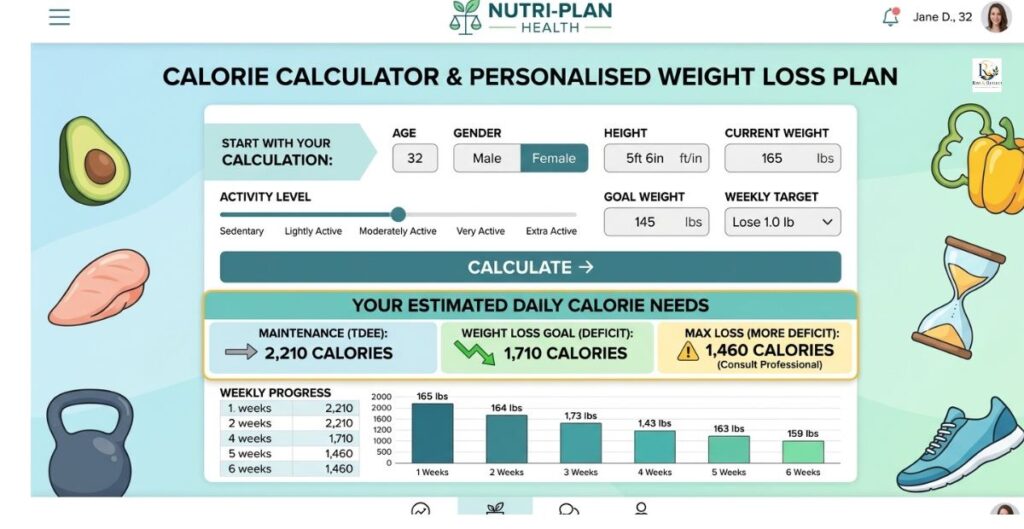
The core idea is simple, a calorie deficit, eating less than your body burns in a day. Most sustainable plans work with roughly a 500-calorie daily deficit, which lands you at about 0.5 kg of weight loss per week.
To find your own number, you first need your maintenance calories, what your body burns just existing at your current weight. This depends on age, height, weight, activity level, and sex. Online calculators using the Mifflin-St Jeor or Harris-Benedict formulas will get you a decent estimate, but roughly speaking: sedentary women tend to sit around 1,600-2,000 calories for maintenance, sedentary men closer to 2,000-2,400, and anyone more active lands higher than that.
Subtract around 500 from whatever your maintenance number turns out to be, and that’s your starting point. Don’t treat it as fixed though, adjust it based on how your body actually responds over the next few weeks. Everyone’s metabolism reacts a little differently, no calculator captures that perfectly.
How Many Calories to Lose 1 kg?
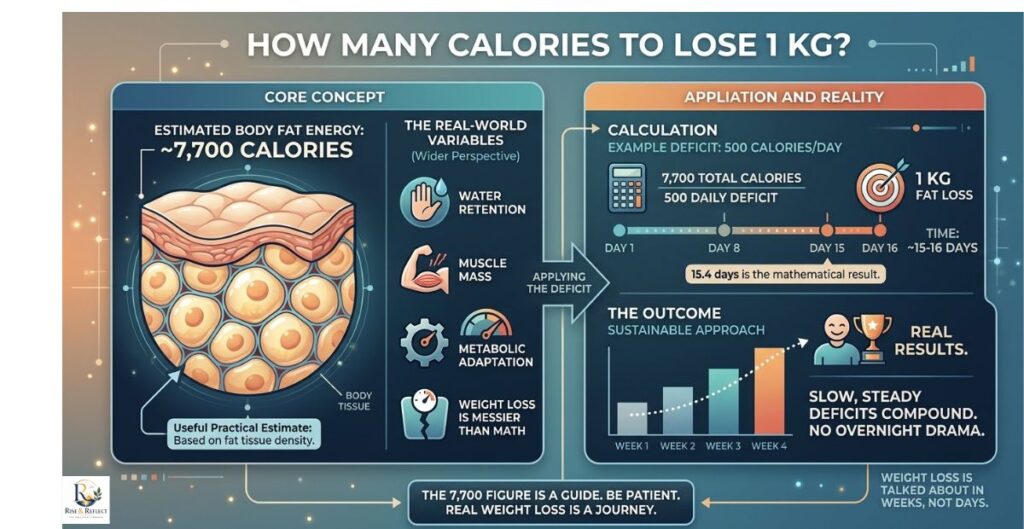
This gets searched constantly, and the commonly cited figure is around 7,700 calories per kilogram of body fat. That number comes from the energy density of fat tissue itself, and while it’s a useful practical estimate, real-world weight loss is messier than the math suggests, water retention, muscle mass, and metabolic adaptation all play a role too.
Still, using that figure: a steady 500-calorie daily deficit works out to roughly 15-16 days to lose 1 kg (7,700 divided by 500 is about 15.4). Which is exactly why sustainable weight loss gets talked about in weeks, not days. Slow, steady deficits compound. They don’t produce overnight drama, but they actually work.
How Many Calories Should You Eat to Lose Weight (for a 75 kg Woman)
This varies with height, age, and activity level, but as a general estimate: a 75 kg (about 165 lb) woman who’s moderately active might maintain her weight around 2,000-2,200 calories a day. A sustainable deficit for her would land somewhere around 1,500-1,700 calories, reflecting that standard 500-calorie cut.
If she’s more sedentary, maintenance likely sits closer to 1,800-2,000, which would put a weight-loss target nearer 1,300-1,500 calories. These are ballpark figures, plugging your actual height, age, and activity level into an online calculator will get you something more personalized. One important line not to cross, though: calorie intake shouldn’t drop below around 1,200 a day for women without medical supervision. Below that, you’re risking real nutrient deficiencies and muscle loss, not just a faster result.
How Long Will It Take to Lose 20 Pounds Eating 1000 Calories a Day?
Purely mathematically, 1,000 calories a day creates a substantial deficit for most people, and using that 7,700-calorie-per-kg figure, losing 20 pounds (roughly 9 kg) could theoretically take somewhere around 10-12 weeks. But let’s be honest about what that actually means: 1,000 calories a day is classified as a very low-calorie diet, and it’s not something to attempt without a doctor actively monitoring you.
Diets this restrictive tend to come with real costs. Significant muscle loss alongside the fat loss. Nutrient deficiencies, since it’s genuinely hard to hit your vitamin and mineral needs eating that little. A metabolism that slows down over time as your body adapts to conserve energy. A much higher risk of binge eating, or rapid regain once you go back to normal eating. And on top of all that, fatigue, irritability, and trouble concentrating, which makes daily life harder while you’re doing it.
If you’re seriously considering something this restrictive, work with a doctor or registered dietitian who can actually monitor your health through the process. For most people, a more moderate deficit, somewhere in the 1,200-1,600+ calorie range depending on your individual numbers, gets you to the same 20-pound goal safely. It just takes a bit longer, and that’s fine.
Tips for Actually Sticking to Your Number

Knowing your target is only half the equation, sticking to it is the harder part. Track your intake with an app for at least the first few weeks, most people are surprised by how far off their mental estimate of “normal portions” actually is. Prioritize protein and fiber, both keep you fuller on fewer calories, which makes the whole thing feel less like deprivation. Plan meals ahead when you can, hunger plus no plan is a recipe for impulsive, calorie-dense choices. Build in some flexibility too, overly rigid restriction tends to backfire eventually. And reassess every few weeks, your calorie needs shift as your weight drops, so the number that worked in week one won’t necessarily work in week eight.
Frequently Asked Questions
How many calories should I eat per day to lose weight? Most people do well with a moderate deficit of roughly 500 calories below maintenance, which typically works out to around 0.5 kg lost per week.
How many calories does it take to lose 1 kg? About 7,700 calories equal 1 kg of body fat, meaning a consistent 500-calorie daily deficit takes roughly 15-16 days to lose that kilogram.
Is 1000 calories a day safe for weight loss? Generally, no. It’s considered a very low-calorie diet and isn’t recommended without medical supervision, given the risks of muscle loss, nutrient deficiencies, and a slowed metabolism.
Do I need to count calories forever to maintain weight loss? Not necessarily. A lot of people move from strict tracking toward more intuitive eating once they’ve built a real sense of portion sizes and habits that stick.
Why am I not losing weight even in a calorie deficit? Usually comes down to inaccurate tracking, water retention, stress, or overestimating how many calories exercise actually burns. Taking a hard look at your real intake for a week often clears it up.
Final Thoughts
Figuring out how many calories should you eat to lose weight doesn’t need to be complicated, even though it can feel that way with all the conflicting advice out there. A moderate, sustainable deficit built around your actual maintenance number will take you a lot further than extreme restriction ever could — and it won’t leave you running on empty the whole way there.
The honest answer to how many calories should you eat to lose weight isn’t a single magic number you’ll find in a random Google search. It depends on your maintenance calories, your activity level, and honestly, how sustainable a given number feels for you day to day. The math matters, sure, but so does giving your body enough fuel to actually function while you’re losing weight.
So if you’re still wondering how many calories should you eat to lose weight, here’s the simple version: calculate your estimated maintenance calories, subtract a moderate deficit (not an extreme one), and track your intake for a week to see how your body actually responds.
Once you know how many calories should you eat to lose weight based on your own numbers, the rest gets a lot easier. Small, sustainable changes — not drastic overnight cuts — are what actually stick. And honestly, that consistency is the real answer to how many calories should you eat to lose weight in the long run.